By Rhia Moore
In the teaching of History at secondary school, Year 7 often begins with the same foundations to fit the National Curriculum. Students must ‘understand a chronological narrative, from the earliest times to the present day’, grasp ‘abstract terms such as empire’, and ‘understand the methods of historical enquiry, including how evidence is used rigorously to make historical claims’. All of this must be done through the teaching of the development of Church, state, and society in Medieval and Early Modern Britain, thus Medieval History is a staple of the Key Stage Three curriculum. Medieval Britain offers much scope for the teaching of women, but it is not explicitly recommended within the current National Curriculum framework.
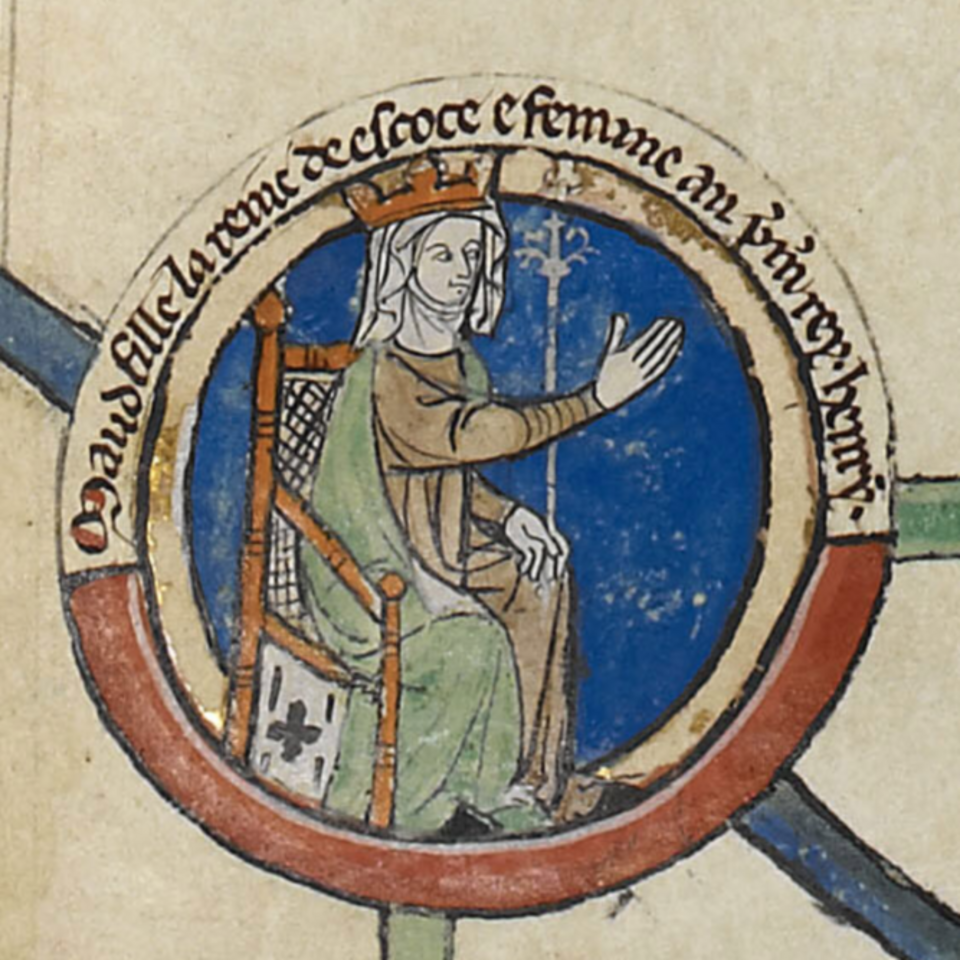
This absence isn’t because the stories don’t exist. Key contributors and famous figures (Empress Matilda, Eleanor of Aquitaine, Joan of Arc) or contributions by women to specific social roles (abbesses, midwives, wise women) were essential to life in the medieval period. However, women are lacking from our curricula even in KS3, where teachers aren’t restricted by exam board specifications.
Since qualifying as a history teacher in 2022, I’ve seen women taught in various topics familiar to us all: Mary I, Elizabeth I, Emmeline Pankhurst, and Emily Davison. Yet rarely are medieval women included. During the summer holidays, I decided that this needed to change. Despite never having studied Empress Matilda at university (my medieval focus was mostly Margaret of Anjou and early medieval witchcraft), I set out to create a Year 7 lesson around the enquiry question:
Should we remember Matilda as a Queen of England?
It was one of the quickest lessons I’ve ever planned and is currently one of the most successful lessons I teach, two years on. Students are immediately hooked by the introduction of women into medieval history. They are outraged by Matilda’s marriages, by the barons abandoning their promise, and fascinated by the power struggle between the cousins. Many can see why Stephen was chosen, but they often believe Matilda should have been picked regardless. This lesson generates excitement for medieval history that is inseparable from its female focus.
This post now breaks down that lesson. This is not to suggest my lesson on Matilda is perfect, or the best way to teach this complex time in English history. But this lesson has now shaped how I plan my school’s Medieval Realms scheme and, I believe, highlights how teaching medieval women does not need to be tokenistic.
The Lesson: Empress Matilda for Year 7
Following a recall starter activity in line with school policy, the lesson begins with a question:
How far do you agree that women were treated more harshly by the law in the Middle Ages?
Most students strongly agree, creating an important starting point for challenging misconceptions about gender in the medieval world. This task also gives the teacher a quick assessment of the class view.
Students then explore the key players of Matilda and Stephen – their personalities, backgrounds, and claims to the throne. Students enjoy judging who should have been monarch in 1135. Crucially, they learn that no woman had ever ruled England in her own right, prompting rich discussion about precedent, hereditary rights, and social expectations.
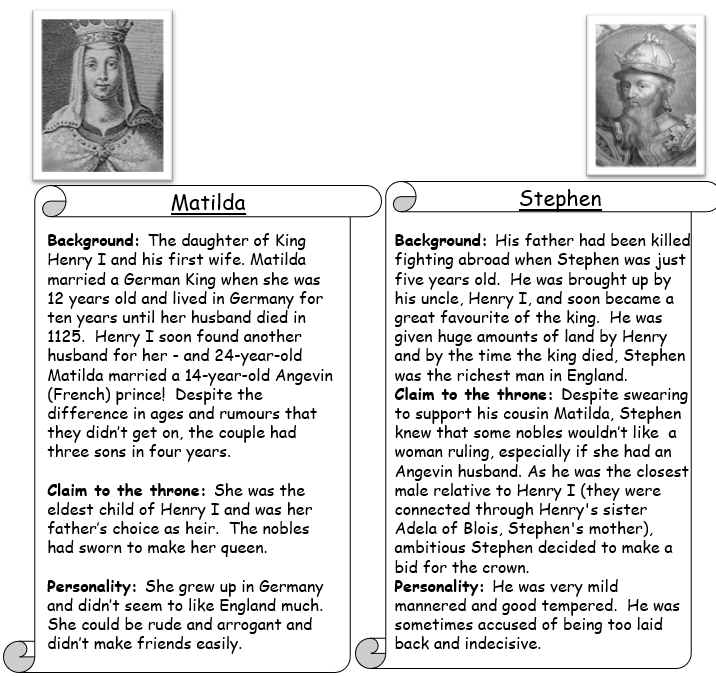
Typical student arguments include:
“Matilda deserved the throne because she was the eldest remaining child of the last king and a grandchild of William I.”
and:
“Stephen should have been king because he was raised by Henry I, well liked in England, and lived there, unlike Matilda.”
These debates cut cleanly across gender lines – Matilda consistently wins more support than Stephen, regardless of the class.
Students then complete a rapid summary of the civil war years through easily identifiable events in Matilda and Stephen’s struggle for power. This ensures every student has the essential chronology in place at a micro level.
Armed with this information, students produce a short ‘on the one hand, on the other hand’ paragraph answering:
Who won the argument ‘Who should rule England?’
There is a clear success criterion for this independent writing task, and it encourages students to utilise their learning from the lesson to practise evidence-based argument and produce a historical judgement.
Finally, students return to their judgement line from the start of the lesson and judge whether Matilda should be left out of our list of English kings and queens.
Why this lesson works
- Pedagogy – This lesson prompts students to engage in significant independent thinking. They must make multiple judgements, supported with evidence or prior knowledge. They return to ‘big questions’, building confidence and, I hope, their intrinsic motivation to learn is activated.
- The story – Matilda’s struggle is dramatic, complex, and full of political intrigue. It holds up in today’s world as immensely entertaining – HBO’s House of the Dragon is loosely based on this period. Medieval history is full of other equally fascinating female-centred stories. The potential for teaching medieval women in KS3 is only limited by the National Curriculum and individual school requirements.
- It enriches my existing curriculum – This Matilda lesson serves a purpose in including women in my school’s Medieval Realms scheme of work. However, it is not tokenistic; it fits seamlessly into a monarchical thread (William I → Matilda → Henry II → John), reinforces chronology, and supports the KS3 requirement to understand the development of the state.
My challenge and reflections
In January 2025 I attended the Medieval Women: In Their Own Words exhibition at the British Library. It was here I ran into some of the TMW team and, as such, my desire to overhaul this Year 7 Medieval Realms scheme was born. This is the task I will now undertake (with the help of gained time this summer term).
In doing so, I am presented with a significant challenge and ambitious task. My school, a Derbyshire state school with 1,200 students on roll, only has a two-year Key Stage 3, thus all the requirements of the National Curriculum must be compressed over 6 terms. Thus, my students do not have the luxury of time: they must reach the Twentieth Century by the end of Year 8, ideally up to the Second World War. This means our medieval unit of about 12 lessons must cover everything from pre-Anglo-Saxon Britain (350BCE) to the Black Death (1348 CE) by Christmas.
From 350 BC to 1348 CE.
Again, ambitious.
With only this limited amount of time, it would have been easy for me to abandon any attempt to include more women into the curriculum. Even within a three-year KS3, many GCSE modules are so modern-centric that teachers may feel unmotivated to spend significant time on medieval history. These GCSE modules also have a distinct lack of inclusion of women means teachers and curriculum leads are guided to pay less attention to medieval women and leave teachers unmotivated to spend significant time on medieval history. However, I believe this makes the work of the KS3 medieval curriculum even more important. Women’s roles in history should be flagged early, at KS3, to ensure we have given students an inclusive experience of history. The teaching of medieval women is worthwhile, and the Matilda lesson is my model which demonstrates the importance and enjoyment students and teachers gain from teaching medieval women.
The limitation of two years means my choices for the overhauled ‘Medieval Realms’ scheme must be purposeful as a ‘chronological narrative’ must be grasped, abstract terms such as empire, parliament, and peasantry must be deployed, and ‘methods of historical enquiry’ should be secured. This must all be achieved with the most impactful stories possible. I believe to ignore the contributions of medieval women would be a narrow-minded interpretation of the National Curriculum.
My goal is to develop a Medieval Realms scheme that gives students broad historical experience; to challenge students’ assumptions about power, gender, and authority in the medieval world; and to make women present again in the curriculum, just as they were present and not passive in their own times.
I move forward with the success of the Empress Matilda lesson and hope to emulate this across a term’s worth of lessons.